


Click HERE to read the original article on Medium.com
Let me start with the disclaimer that this article is not meant to be political — only financial. I will attempt to decipher what is happening in Washington and how it may influence the stock market. I am not “taking sides” with what is going on in Washington.
As the impeachment process gets underway in the US House of Representatives, President Trump used his preferred method of mass communication, Twitter, to let the country know that his impeachment would result in a stock market crash:
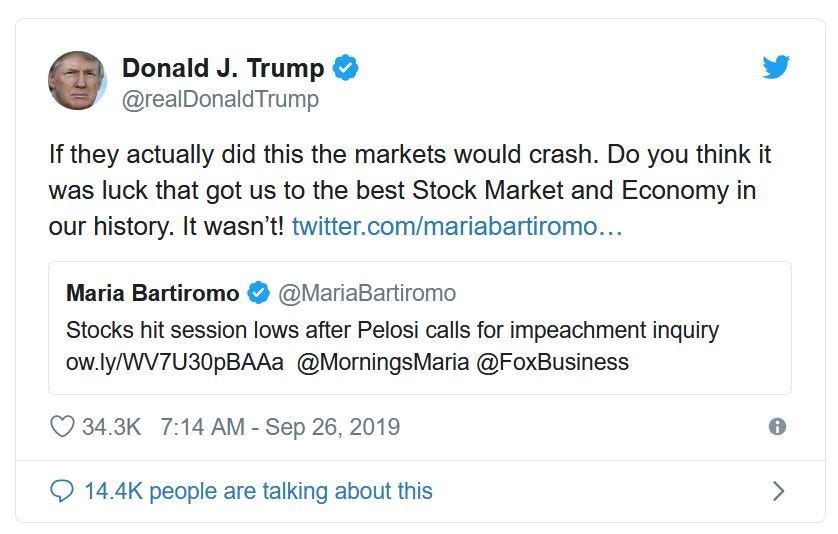
As I pondered this potential in meetings with clients, I decided to look back through history to see what happened during the last two impeachment proceedings of President Nixon and President Clinton.
Let me remind everyone that past performance is not indicative of future results, and since we only have two impeachment proceedings to review, the sample size is incredibly small.
To further complicate the issue, both impeachment proceedings produced very different results.
William Jefferson Clinton
Most citizens forget that impeachment discussions were started long before the Monica Lewinsky scandal came to light. House Resolution 304 was introduced in the fall of 1997, requesting impeachment proceedings related to Clinton campaign fundraising from foreign sources. The resolution was ultimately tabled by the House Rules Committee.
It wasn’t until almost a year later, in October 1998, that the full House voted to commence impeachment proceedings against President Clinton for “high crimes and misdemeanors” which were defined specifically as lying under oath and obstruction of justice. The House formally adopted the impeachment articles in December 1998 and sent the matter to the Senate for trial.
The Senate failed to convict the President by the required two-thirds majority vote.
So what did the stock market do during all of this?

Initially stocks fell in anticipation of the release of the report from independent counsel Ken Starr, with the S&P 500 down over 19% from July 17th of 1998 through the report release date on September 9th. After that decline however, the stock market rallied, and 100% of the decline was recovered by the end of November of 1998. Impeachment proceedings were still going on, and the House was still over a month away before rendering a conclusion.
From the date that the House actually voted to start impeachment proceedings (October 8th 1998) through the date of the Senate’s acquittal (February 12th 1999) the S&P 500 climbed about 28%.
So does this mean impeachments are good for the market?
Not necessarily. Let’s look at our next example:
Richard Milhous Nixon
From the date the Watergate burglars were arrested (June 17th 1972) through the date of the President’s resignation (August 9th, 1974), the S&P 500 declined by approximately 24%.
Coincidence, Causation, or Something Else?
I would be doing our clients a disservice if I ended this article with the takeaway that the stock market has increased 50% of the time in previous impeachment inquiries (or has fallen 50% of the time). What is missing in this discussion is a summary of the other economic conditions present during both proceedings.
In the case of President Nixon, the Organization of Petroleum Exporting Countries (OPEC) announced an embargo on oil shipments to the US and other Israeli allies in October 1973, which created shortages and long lines at US gas stations. Oil prices just about quadrupled over the next few months.
Increased costs at the gas pump bled over into other parts of the economy as well, and by 1974 inflation had topped 11%.
I believe it was the combination of the oil embargo, runaway inflation, and the ongoing Vietnam war that ultimately caused the 1973–74 bear market. President Nixon’s impeachment proceeding and ultimate resignation didn’t help, but I don’t think it was the cause.
Arrival of the Dot Com Bubble

With President Clinton, we were in a different economic environment — the early stages of the dot com bubble. On the day the Senate voted to acquit President Clinton, the share price of Corning Incorporated Stock (GLW) closed at $16 per share (split adjusted). By the end of that year, Corning closed at almost $43 per share (split adjusted). Less than a year later, Corning peaked at $107 per share (split adjusted) or $321 per share non-adjusted.
The dot com rally that benefited Corning, and many different companies, had nothing to do with relief from the impeachment proceedings. The US economy was expanding in this tech boom, we had a balanced Federal budget, and Al Gore invented the internet (okay — just kidding — I wanted to reward those who have read this far with a little humor).
So where do we go from here?

The impeachment process should mean much more to Washington, and even “Main Street” than it does to Wall Street. This isn’t to say that it won’t influence the markets, as it certainly may, especially if additional “smoking gun” material is presented about the President’s behavior.
That said, I think this market will continued to be dominated with uncertainty surrounding any future trade deals with China, uncertainty surrounding future Federal Reserve rate cuts, and uncertainly surrounding any number of geopolitical issues such as continued threats from Iran or even Brexit.
Unlike the Nixon years, our economy continues to benefit from low inflation, low unemployment, low interest rates, and low oil prices.
President Trump may believe that the stock market is all about him, and most likely previous Presidents have thought the same thing. In reality, there are other economic forces that have a much greater influence on stock prices than the winds of politics.
Sources referenced in this article:
About the author
William B. Burns, Jr. CFP® is a CERTIFIED FINANCIAL PLANNER professional and President of Burns Matteson Capital Management, a Financial Planning and Investment Advisory Firm with clients throughout the United States. He helps high-net-worth families reduce the worry and anxiety sometimes associated with wealth, allowing families to reclaim that time to reinvest back into their family, social, and professional relationships. www.BurnsMatteson.com
 Eric Sweet, FPQP®
 Nathan R. Burns, MBA
 Christopher Davis, CFP®
 Kelley Zimmerman, FPQP®
 William B. Burns JR., CLU, ChFC, REBC, CFP®
 William F. Redder