

The lead story yesterday was a 2,000 point decline in the Dow Jones Industrial Average. When I entered the financial services industry in 1990, the Dow Jones was worth about 2,600 points. It’s hard to fathom a drop of 2,000.
In point terms, this was the largest drop in history. In percentage terms, yesterday’s decline didn’t even break the “top 10” worst days. The “largest point drop in history” sounds very ominous – but let’s not forget the “largest point increase in history” happened just one week earlier – last Monday – when the Dow moved higher by almost 1,300 points.
I thought it would be helpful to explain the effects that oil prices and interest rates had on the market Monday. It might be hard to believe, but the actual Coronavirus news was relatively benign on Monday. Oil prices and interest rates are a different story…
Here’s what I want to cover today:
- Oil Prices and Interest Rates – the circular effects on Banks and Energy
- Coronavirus Update – 47,000 sick, not 116,000
- What we need to see for a bottom in stocks
Oil Prices and Interest Rates – the circular effects on Banks and Energy
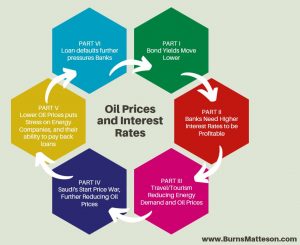
Part I: As the stock market has become more volatile, we’ve seen an inflow of buyers to the bond market. As bond prices have been bid up, bond yields have fallen, resulting in historically low interest rates on the ten-year US Treasury security.
Part II: Banks need higher interest rates to be profitable. Banks make money on the “spread” between what they charge for loans, and what they pay out for savings/deposit products. As interest rates fall, that spread gets very thin, reducing the profitability of banks.
Part III: The travel and tourism industry has been hit hard by the Coronavirus fears. This has led to cancellations of large conferences and festivals in the US, resulting in fewer plane tickets being sold, as well as fewer cruise ship bookings. All of this results in lower energy needs for these industries that typically purchase a lot of fuel. This reduction in “demand” would send energy prices lower, if “supply” remains the same.
PART IV: In the past, whenever there was a reduction in demand for energy products, energy producers would often reduce their output. In other words, if there weren’t enough buyers for oil, there was no need to pull it out of the ground. This would temporarily reduce the “supply” of oil, resulting in price stability to match the current “demand”. This changed this weekend, when OPEC promoted the idea of supply cuts, but Russia (who is not an OPEC member but has gone along with their policy decisions in the past) decided against cuts. This enraged the Saudi’s, who instead announced an across-the-board price cut for their oil exports. As the Saudi’s well know, the price of oil is global, not local, so their price cuts reverberated across the market and caused oil prices around the globe to fall. They are betting that they can outlast the Russian’s, since the Saudi’s cost of production is lower than Russia’s.
PART V: Lower oil prices, if they stay at current levels, will make it difficult for many US energy companies to remain profitable. The energy business is a capital-intensive business, and most companies rely on loans for their working capital and exploration projects. If oil prices remain depressed for a long time, many of these companies will be forced to lay off employees, some companies will have difficulty making their loan payments, and some companies will go bankrupt.
Part VI: Low energy prices, and the potential for loan defaults from energy companies, will put further pressure on the banks, who are already seeing their profitability erode due to the lower interest rates referenced in Part I.
It is this circular effect that low interest rates have on banks, and low oil prices have on energy producers, that fueled (no pun intended) the market decline on Monday.

Coronavirus Update – 47,000 sick, not 116,000
In our last market update I referenced the John’s Hopkins Coronavirus Tracker.
In that piece, I also referenced the approximately 33,000 people who have recovered from the Coronavirus. As of this morning, the amount of recoveries has topped 64,000.
There is a different tracker out there that provides a very accurate daily count of cases and recoveries which you can view here:
https://www.worldometers.info/coronavirus/
Here’s a screen shot from this morning:
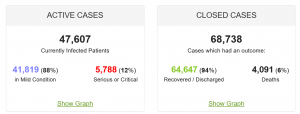
The media continues to focus on the total number of humans infected over the past three months, which currently totals approximately 116,300 people.
That is an accurate number, but what gets missed in reporting that gross number is that close to 69,000 cases have already been resolved. 64,600 people have recovered, and 4,100 people have sadly passed away.
This leaves 47,600 “active” cases across the globe, in a population of 7.8 billion.
Of these 47,600 active cases, only 12% of cases are termed “serious or critical”, which totals approximately 5,800 people across the world.
If you scroll down a bit on that website, you can see the total number of serious cases by country. In the US, we currently have 700+ cases diagnosed, but only 8 are currently listed as serious or critical.
Other positive news, in China, where everything started, they only have 17,500 active cases remaining. Over 60,000 people have recovered in China. In fact, they only reported 26 new cases yesterday, in a population of 1.4 billion people.
I don’t want to downplay the effects the virus has had on our physical and mental health over the past month, but 88% of the active cases around the globe are categorized as “mild” with symptoms that are similar to the common cold and require no hospitalization.
Because of the large number of mild cases, my guess is that the actual number of people who have been infected with the virus is significantly higher than the 116,000 published figure. If that is the case, and the total number of infections is higher, but the number of deaths remains similar, we should see the final death rate number fall closer to that of the seasonal flu virus.

What we need to see for a bottom in stocks?
1: We need to see a slowing Transmission Rate for the Coronavirus
We’ve seen the transmission rate of the Coronavirus slow in China (only 26 new cases yesterday) as well as in S. Korea (35 new cases yesterday). We’ll need to get confirmation that it is slowing in the US as well. This might take several weeks. The combination of our stepped-up personal hygiene habits (most stores have sold out of hand sanitizer), the heightened diligence of our population due to the media coverage, and the seasonal warmer weather should all help in the coming weeks and months.
The Coronavirus situation isn’t as dire as it might seem. The transmission of the virus has already slowed in the regions first infected, as compared to a month or two ago, it just doesn’t seem that way since its in more countries now (just in smaller numbers so far as compared to China). I’m sure it will get worse before it gets better in the US, but as we’ve seen in China, ultimately the rate of infection will slow down, it will just take time.
2: We need to see Treasury yields stabilize
As positive news starts to trickle out about the Coronavirus, we should ultimately see Treasury yields start to tick higher again as some of that money moves back into stocks. That will improve the spread for banks and help their profitability.
3: We need to see oil prices move higher
It is doubtful that the Russian’s expected the Saudi’s to announce such large price cuts, and it is doubtful that the Saudi’s thought their announcement of $6 to $8 per barrel cut (about 15% or so) would result in the price of oil tanking by 24%. Both the Saudi’s and Russian’s have an incentive to compromise here.
Higher oil prices will help stabilize US energy companies, and provide more cushion to US Banks.
4: We need to see some sort of stimulus plan out of Washington
Stocks were up earlier today, and part of the reason for the move is the announcement by the President on Monday that he planned to work with Congress to put measures in place that would help US businesses and workers with the economic stress brought on by the Coronavirus.
Some ideas floated were a temporary payroll tax cut, and sick leave for hourly employees who are afraid of being unable to work due to quarantine measures. He also talked about loans for small businesses and some specific stimulus for the airline and cruise industry.
Of course, the “devil is in the details”. If a plan is put forth quickly, we may see more positive market follow-through. If however it looks like any plan might fall victim to political games (on both sides of the aisle) then enthusiasm will quickly fade.
—————————————————————————————————————————
I have no doubt that volatility will continue in the coming weeks, but it is important to remember that volatility moves assets both up and down. It’s hard to believe, but the Dow Jones was actually higher last week. From Friday 2/28 through Friday 3/6 the Dow was up 455 points. It started its recovery from the week before, before being derailed yesterday with the oil and interest rate issue.
Our biggest fear is the toll this recent patch of market volatility will have on consumer confidence, and therefore consumer spending. This could cause corporate earnings to fall for at least the next two quarters before hopefully recovering later in the year. We’ll be watching this closely in the coming months.
As I mentioned in our last note, for clients who are purchasing new homes or new cars, sending their children to college, or retiring in the coming months, we’ve already set aside the money needed for those endeavors in the more conservative-to-moderate parts of your portfolios.
For clients who rely on their portfolios for month-to-month income, we tend to keep anywhere from 5 to 15 years worth of monthly withdrawals in the more conservative-to-moderate parts of your portfolio, more than enough to provide for any month-to-month needs without needing to sell stocks in this volatile environment.
About the author
William B. Burns, Jr. CFP® is a CERTIFIED FINANCIAL PLANNER professional and President of Burns Matteson Capital Management, a Financial Planning and Investment Advisory Firm with clients in 21 states throughout the US. He helps high-net-worth families reduce the worry and anxiety sometimes associated with wealth, allowing families to reclaim that time to reinvest back into their family, social, and professional relationships. www.BurnsMatteson.com
 Eric Sweet, FPQP®
 Nathan R. Burns, MBA
 Christopher Davis, CFP®
 Kelley Zimmerman, FPQP®
 William B. Burns JR., CLU, ChFC, REBC, CFP®
 William F. Redder