


Click HERE to read the original article on Medium.com
Most families have a desire to see their children, grandchildren, and great-grandchildren thrive and prosper. One way this is accomplished is by passing on the assets we’ve accumulated over our lifetimes.
What assets?
- Financial Assets
- Knowledge and Experience Assets
- Cultural and Avocation Assets
- Core Value Assets
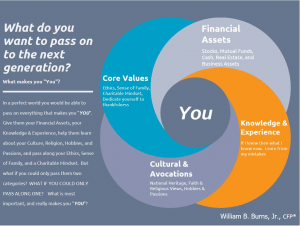
Multiple Family Assets—Burns Matteson Capital Management
When we think about assets, most people naturally think of “financial” assets. Stocks, bonds, mutual funds, cash, real estate, and business ventures are all important assets that can be passed on to future generations — but are these all of your assets?
What about your “knowledge and experience”. What if you could help the next generation learn from your mistakes? What if you could teach them some of the skills you acquired that allowed you to be successful in the corporate world or as an entrepreneur? The knowledge and experience you have accumulated over your lifetime is also a family asset.
Would you like the next generation to know about your “culture and avocations”? Are you a proud Irish-American? Do you have stories to share of your grandparents or great-grandparents growing up in Italy? How they sacrificed to come to the United States? Do you practice a particular religious faith? What about your hobbies? Has sailing been a big part of your family history? Is teaching the next generation the rules of the water and how to sail important to you? Are you a musician who hopes your children and grandchildren will inherit, or at least appreciate, some of your musical talent?
Finally, how do you view your “core family values”? Your ethics, your sense of right and wrong. Is it important to pass those traits on? Do you have a charitable mindset? Do you try to leave the world a better place each day by supporting causes that are important to you? Do you dedicate yourself to thankfulness? Would you like to know that the next generation also appreciates the opportunities they have been given and are carrying on your charitable legacy? Have you discussed a charitable legacy with your family?
All of the “assets” reviewed above are wonderful gifts to be passed on to future generations, and in a perfect world, you could pass on all of those assets. How would your life or outlook change if you couldn’t pass along all four categories? What if you could only pass along two categories? Could you choose?
If you could only choose two categories, most families would want to pass along their financial assets, so that future generations could benefit from the hard work and success of previous generations. I think most families would also want to pass along their core values, family ethics and charitable mindset. Any child or grandchild would be incredibly fortunate to receive those assets from you, even without the benefit of your knowledge, experience, cultural history, and avocations.
Here comes the tough part. What if you could only pass along one asset? What would you choose? Would you elect for future generations to receive your financial wealth without any knowledge of your core values that allowed you to generate that wealth in a fair and ethical manner? Would you feel that you personally lived up to the definition of “successful” if future generations knew nothing of your core values, even if they inherited a lot of financial assets?
Hopefully no family needs to make this choice, and you can all pass on everything that makes you “YOU”. To help ensure this though, how much time have you spent cultivating your other assets?
Have you spent time with your family talking about your formative years and what the driving factors were with you selecting your particular career? Do your children know of the successes and failures you encountered as an entrepreneur? How about spending time reviewing your heritage? Have you taken any trips to the birthplace of your grandparents or great grandparents? Have you included your children in the decision-making process for some or all of your charitable gifting? Do they know why you support certain causes?
I’d like to focus on some ways that families can get their children more involved in their charitable giving and help to pass on their charitable mindset to the next generation.
Family Meetings:

Photo Credit: Hillary Fox
Set some time aside to include your family members in your decision-making process about the charities you support.
Your family meeting could be a simple discussion at dinner, or perhaps you could set aside a dedicated time for a specific “family charitable discussion”. The more effort you put into the discussion process, the more attention you’ll garner from the rest of the family.
You could explain what charities you plan to support over the course of the year, and if you are comfortable sharing with your children, let them know the budget you have set aside for your support. You could also let the children know that you have budgeted a certain amount to be directed by the children. You could give the children an opportunity to research different charities and prepare a short presentation to give to the family about why the family should support a particular charity.
For young children, their presentation might only focus on their individual feelings about a charity. For older children and young adults, you could ask them to study the annual report from the charity, or look up the fiscal responsibility data about the charity on www.charitynavigator.org.
Charitable Gift Certificates:

Charitable Gift Certificates — Burns Matteson Capital Management
If you didn’t want to formalize your process with a family meeting, you could consider giving a gift certificate to your children (or grandchildren) referencing a dollar amount for them to give away over the course of the year.
A $250 charitable gift certificate (or $100, or $1,000 — whatever works for your family) could be donated in a lump sum, or split up among multiple charities.
Charitable Challenge:

Photo Credit: Julia Casado
Another popular idea with families is to structure a “charitable challenge” with their children. Give them a budget of $100 and ask them to “make an impact”.
If you give a man a fish, you feed him for a day. Teach a man to fish, and you feed him for a lifetime.
— Chinese proverb
For younger children, the impact they might make with a charitable challenge may be similar to the charitable gift certificates above — just selecting a charity. For older children and young adults, I would challenge them to find ways to leverage their gifts.
For example:
- Rather than donating cash to a food pantry, what about coupon cutting and using the $100 to purchase food at deep discounts using coupons, and then donate the larger volume of food.
- What about using the $100 to print flyers to distribute around your neighborhood and organize a food drive for the local food pantry. $100 could print 2,000 flyers. You could distribute the flyers one Saturday, telling your neighbors and community that you will be back the following Saturday to pick up the food items.
- Perhaps use the $100 to purchase seeds and cultivate a vegetable garden. A garden could provide an ongoing supply of fresh vegetables to the local food pantry.
- Consider using the $100 to buy winter clothes in March, at the end of the winter season in colder climates as stores start to make room for their summer inventory, and save the items for a donation to homeless shelters in the fall. To further leverage your impact, purchase the winter items at second-hand stores or Salvation Army stores in March. Your $100 will go much farther than purchasing winter clothes in November from retail stores.
- Similar to the idea with the flyers for the food drive, you could print flyers organizing a clothing drive.
These are just a few ideas of how a young person could leverage the impact of the $100 charitable gift.
What makes you “YOU”?
Hopefully we are all in a position to pass along more than just our financial assets to the next generation. It is these other assets that truly make you “YOU”.
We tend to spend a lot of time and effort cultivating our financial assets and teaching our children about sound money management principles. If you want to make sure that your core values, family ethics, and charitable mindset are also assets that get passed on, then we need to make sure we are spending time cultivating those ideas with the next generations as well.
In our next article I’ll discuss ways that families can utilize Donor Advised Funds to simplify and leverage their charitable gifting. Please follow me to be alerted when that article is published.
About the author
William B. Burns, Jr. CFP® is a CERTIFIED FINANCIAL PLANNER professional and President of Burns Matteson Capital Management, a Financial Planning and Investment Advisory Firm with clients throughout the United States. He helps high-net-worth families reduce the worry and anxiety sometimes associated with wealth, allowing families to reclaim that time to reinvest back into their family, social, and professional relationships.
 Eric Sweet, FPQP®
 Nathan R. Burns, MBA
 Christopher Davis, CFP®
 Kelley Zimmerman, FPQP®
 William B. Burns JR., CLU, ChFC, REBC, CFP®
 William F. Redder